

“Everybody needs beauty as well as bread,” wrote John Muir, “places to play in and pray in, where nature may heal and give strength to body and soul.” More than a century later, psychologists are finding that Muir may have been onto something, and that the key may lie not only in being near nature’s beauty, but in letting ourselves be moved by it.
For years, researchers have studied the link between feeling connected to nature and feeling well. The results have been encouraging but puzzling. In two studies of Canadian university students, Andrew Howell and colleagues found that those who felt more connected to nature reported a stronger sense of purpose, personal growth, self-acceptance, and connection with others. Yet the link with everyday positive feelings was inconsistent, and other studies have found little connection with life satisfaction at all. Something seemed to be missing.
In 2014, psychologists Jia Wei Zhang, Ryan Howell, and Ravi Iyer proposed an answer. Perhaps feeling connected to nature makes the biggest difference for people who also engage with its beauty: those who notice beauty in the natural world and feel genuinely moved by it. Across two studies, one with more than 1,100 adults and another with 151, they measured both how connected people felt to nature and how much they engaged with its beauty.
The pattern was striking. Among people who often noticed and were moved by nature’s beauty, feeling connected to nature went hand in hand with greater life satisfaction and higher self-esteem. Among people who rarely did, feeling connected to nature made little difference. The findings held even after accounting for personality, age, gender, and the tendency to give socially desirable answers.
It may not be enough, in other words, to know that we belong to the natural world. We may also need to pause long enough to be moved by it. The researchers concluded that people who are emotionally attuned to nature’s beauty appear to gain the most from their connection to it.
These were surveys taken at a single point in time, so they can’t tell us whether noticing beauty leads to greater well-being or whether happier people simply notice more beauty. Encouragingly, though, appreciation of beauty may be something we can cultivate. In one small study, ten brief weekly walks devoted to noticing beauty increased participants’ appreciation of natural beauty, an effect still evident weeks later.
Seen this way, delight in nature is less a matter of luck than of attention. A photograph can be an invitation to that kind of attention, especially one that captures a fleeting moment: light touching a ridge, color spilling across water, a canopy glowing in spring. For more on how nature lifts us, see our other articles on Joy, and on the closely related feeling of Wonder.
Try it: Once a day for a week, take a beauty pause. Find one beautiful thing in nature: the color of the evening sky, light moving through leaves, an image on your wall you’ve stopped seeing. Stay with it for 30 seconds. Name, silently, what moves you about it, and let yourself feel it. At the end of the week, notice whether beauty has become a little easier to find.
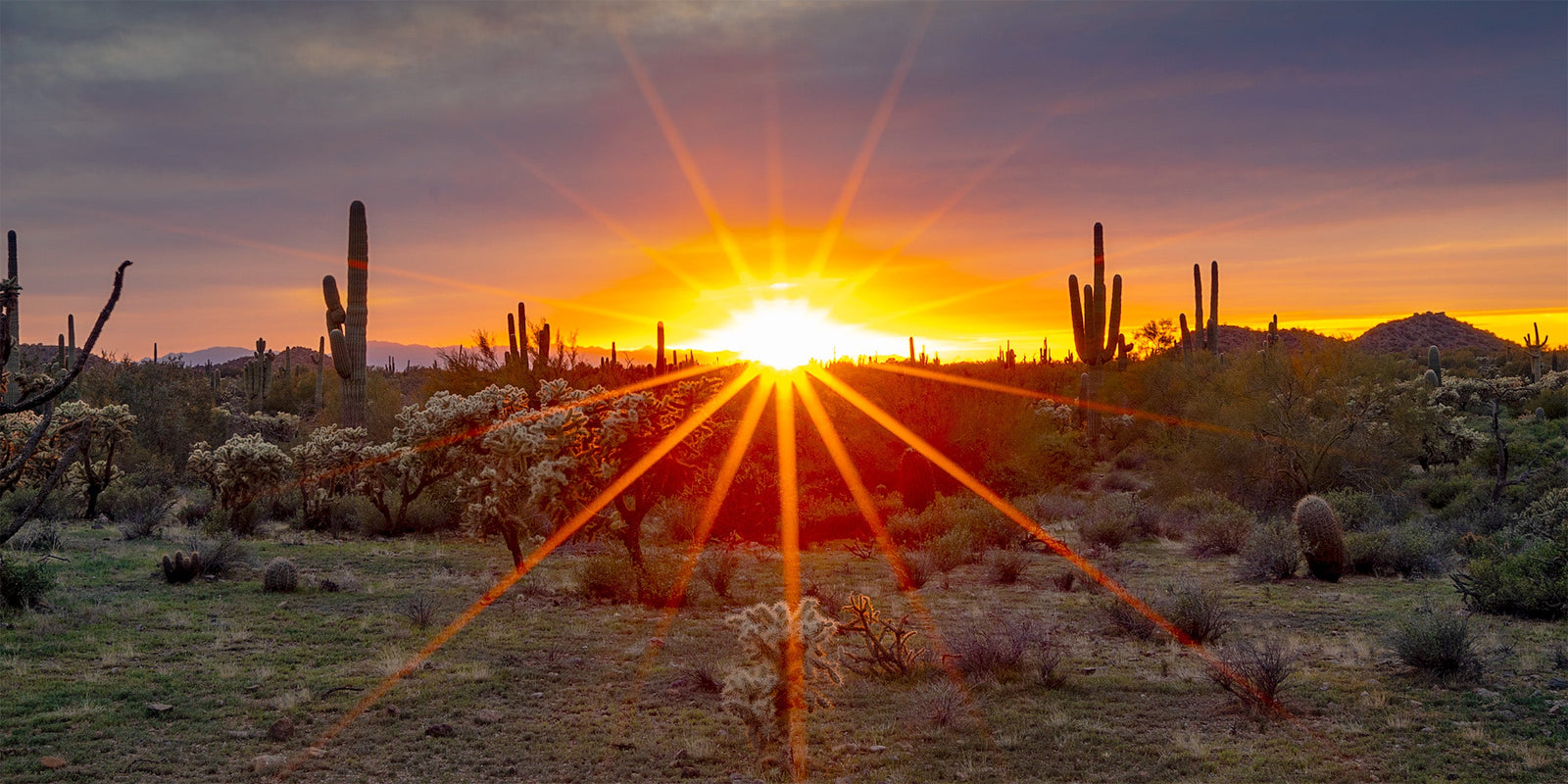
The image at the top of this article, Where the Desert Exhales, captures the last light of evening breaking across the Sonoran Desert in Arizona, a moment that asked only to be noticed. It is available as a print.
Sources: Zhang, J. W., Howell, R. T., & Iyer, R. (2014). Engagement with natural beauty moderates the positive relation between connectedness with nature and psychological well-being. Journal of Environmental Psychology, 38, 55–63. https://doi.org/10.1016/j.jenvp.2013.12.013
Howell, A. J., Dopko, R. L., Passmore, H.-A., & Buro, K. (2011). Nature connectedness: Associations with well-being and mindfulness. Personality and Individual Differences, 51(2), 166–171. https://doi.org/10.1016/j.paid.2011.03.037