

Most of us know the feeling of looking out over a mountain lake: the eyes slow down, the breath deepens, and something in the mind seems to settle. Attention restoration theory, which we explore in our other articles on Clarity, suggests why. Natural scenes hold our attention gently, giving the effortful focus we rely on all day a chance to rest. But can we see that difference in the brain itself?
A 2017 study by researchers at National Taiwan University and the University of Illinois set out to explore that question. It had two parts. In the first, 142 young adults viewed photographs of four kinds of landscapes, city streets, mountains, forests, and water, and rated how restorative each felt, considering qualities such as fascination, a sense of being away, and how well a scene fit their needs. Water and mountain scenes were rated the most restorative, with no difference between them. Forests came next, and city scenes trailed far behind.
In the second part, 31 adults viewed similar photographs while lying in a functional MRI scanner, which tracks changes in blood flow as an indicator of brain activity. Compared with mountains or water, city scenes produced more activity in the cuneus, a region at the back of the brain involved in processing what we see. Comparing city scenes with water also showed more activity in areas associated with directing focus. The researchers interpret this to mean that busy city scenes demand more visual and attentional work, while water and mountain scenes ask less of us, a pattern consistent with the idea that natural scenes let effortful attention rest.
A few cautions are worth keeping in mind. This was a small study, using only three photographs for each type of landscape. The city photographs showed congested streets, so the comparison was partly between busy and calm scenes, not simply between urban and natural ones. Participants always viewed the city scenes first, which could have influenced their brain responses. And forest scenes, though rated far more restorative than city scenes, showed no difference in brain activity from them.
As someone trained in behavioral neuroscience, I’d add one more caution. Brain imaging is a powerful tool, but it doesn’t read thoughts or feelings directly. When a region becomes more active, researchers infer what that activity means from what the region is known to do. Those inferences are informed but not certain, which is why studies like this are best understood alongside behavioral research, like the attention experiments described in our other Clarity articles.
Even with these limits, the study adds to a consistent picture: scenes of nature, especially open water and mountains, are experienced as restorative, and they may place fewer demands on the brain than busy urban scenes. When choosing images to live with, look for scenes that let the eye rest: open water, wide mountain horizons, and compositions that feel uncluttered. You can explore our Water and Mountains collections for examples.
Try it: Let your eyes move around the room you’re in, and notice how often they jump from one thing to the next. Then rest your gaze on an image of still water or distant mountains for a minute. Notice whether your eyes begin to slow, wander less, and settle.
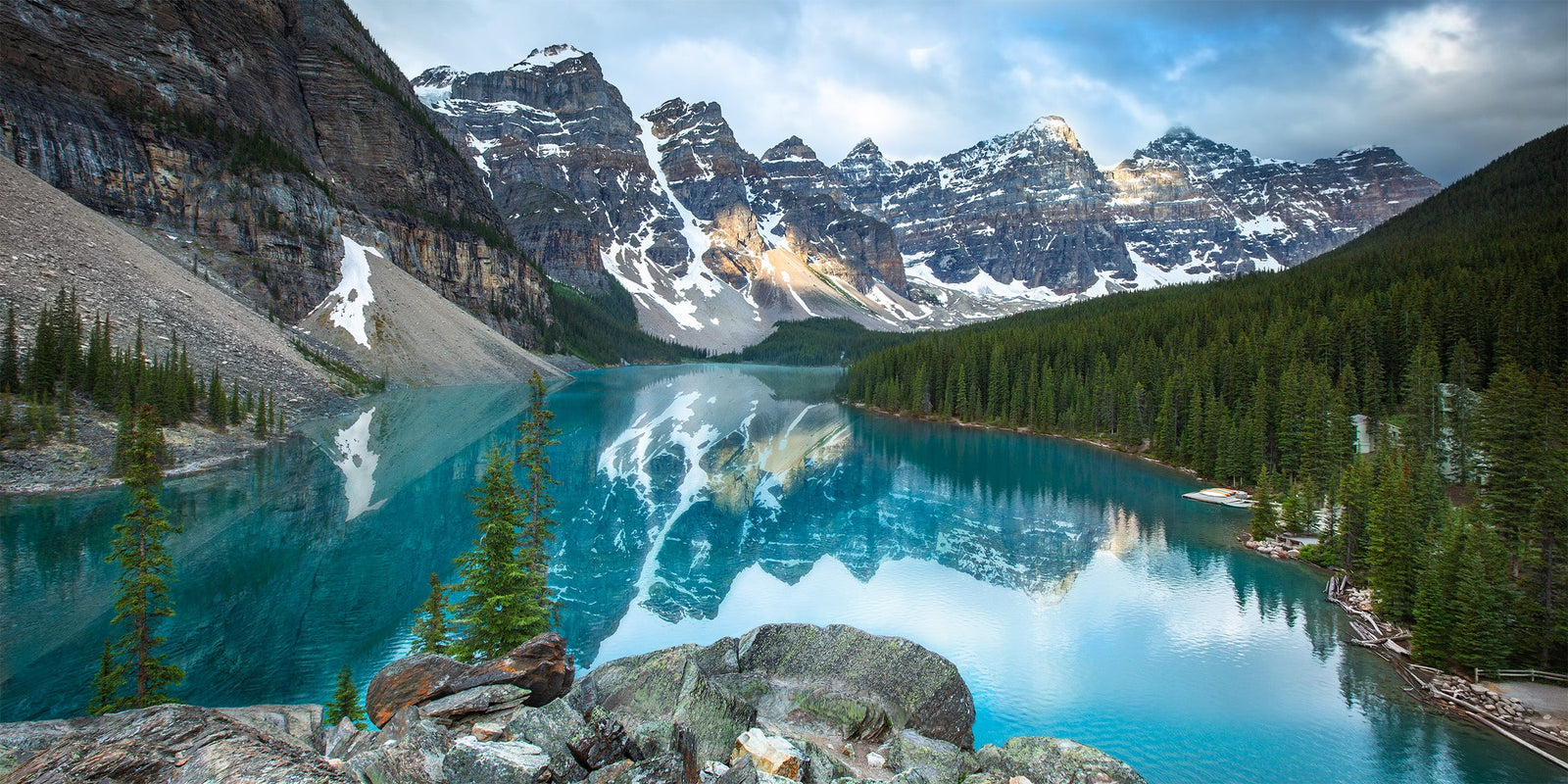
The image at the top of this article, Turquoise Reverie, captures the turquoise water of Moraine Lake beneath the peaks of Banff National Park in Alberta. It is available as a print.
Source: Tang, I.-C., Tsai, Y.-P., Lin, Y.-J., Chen, J.-H., Hsieh, C.-H., Hung, S.-H., Sullivan, W. C., Tang, H.-F., & Chang, C.-Y. (2017). Using functional magnetic resonance imaging (fMRI) to analyze brain region activity when viewing landscapes. Landscape and Urban Planning, 162, 137–144. https://doi.org/10.1016/j.landurbplan.2017.02.007