

Most of us can remember a moment when nature stopped us in our tracks: a canyon opening beneath our feet, a sky crowded with stars, mountains catching the first light of morning. In that moment, the worries we carried seem to loosen their grip. Psychologists call this feeling awe, the emotion we experience in the presence of something so vast that our usual way of understanding the world has to stretch to take it in.
Awe has become one of the most active topics in psychology, and research has linked it with greater life satisfaction and relief from everyday stress. A 2023 study by Jia Liu and colleagues asked a further question: why might awe of nature be good for us, and does every kind of awe help?
Across two experiments, about 500 university students watched a short video, roughly two minutes long. Some saw sweeping footage from the BBC documentary Planet Earth, filmed from high above and set to uplifting music. Others watched time-lapse storms and a tornado forming, set to tense music. A third group watched a man explain how to clean a wooden floor.
Both nature videos inspired awe. But only the beautiful, expansive footage improved well-being. In the first study, students who watched it felt that a stressful event they had recalled weighed on them less. In the second, they reported greater satisfaction with their lives and a stronger sense of flourishing. The key appeared to be connection: positive awe left people feeling more connected to the natural world, and that sense of connection explained much of the benefit. (For more on why connection with nature matters, see our article on Connection.)
The storm footage told a different story. It also deepened people’s sense of connection to nature, but it left them feeling powerless at the same time. The two effects cancelled each other out, and the threatening awe brought no overall gain in well-being.
These studies used short videos with music and measured how people felt right afterward, so we don’t yet know how long the effects last or how they apply to still photographs. Still, they offer a useful idea for anyone choosing images to live with. Look for vastness that feels welcoming: wide horizons, mountains in soft light, a night sky full of stars, a road leading toward distant peaks. Storms and turbulent seas can be breathtaking, and they have their place in art. But in the spaces where we seek well-being, grandeur that feels safe may serve us better.
Try it: Choose an image that makes you feel small in a good way, one that opens outward rather than closing in. Spend two minutes with it. Let your eyes travel to the farthest point in the scene, and notice its scale. Imagine standing at its edge, breathing its air, part of something much larger than the day’s concerns. When you finish, notice whether the worries you brought with you feel a little lighter.
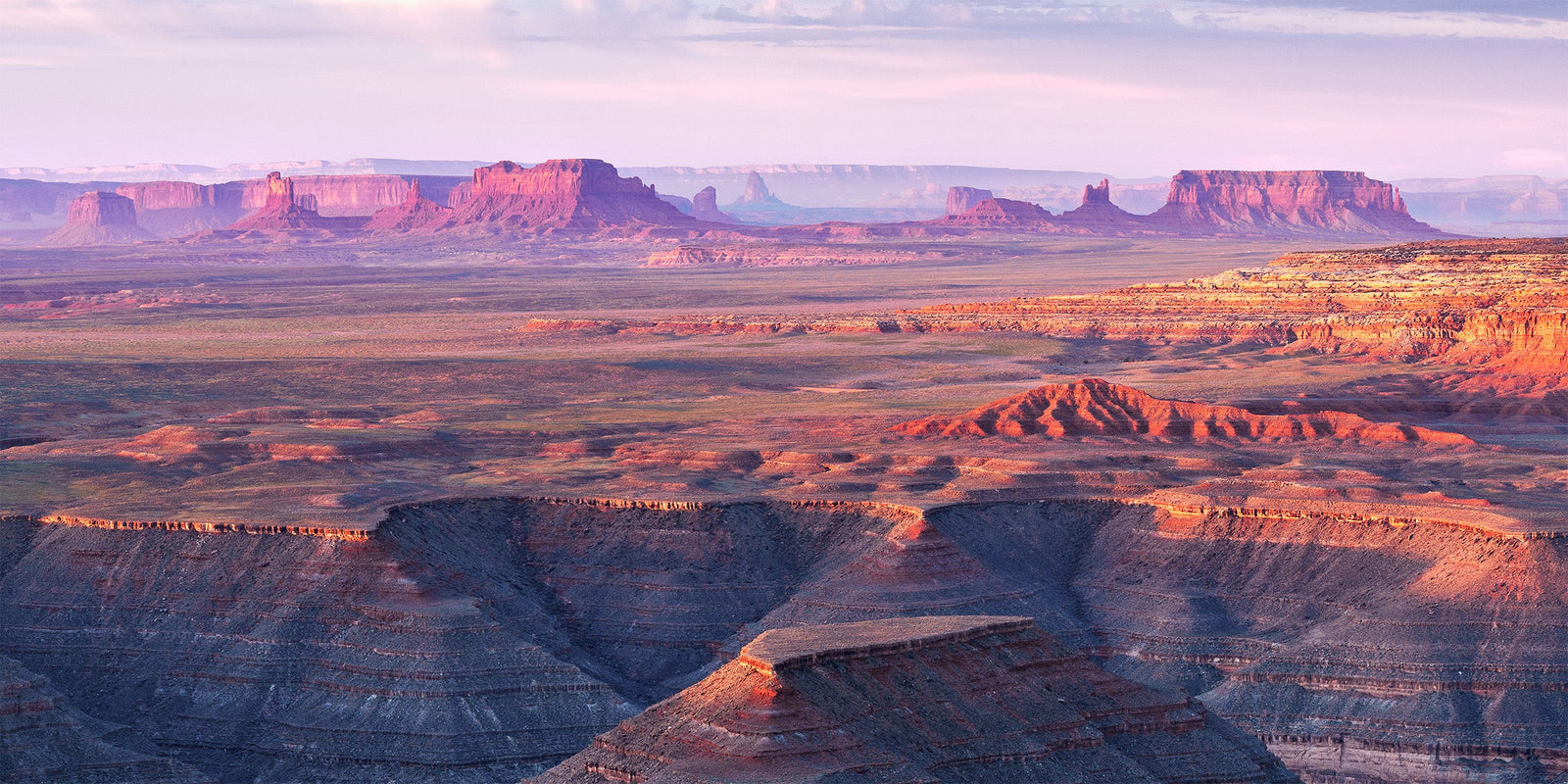
The image at the top of this article, Muley Point, captures first light reaching across the desert to the distant buttes of Monument Valley, seen from the canyon rim in Utah. It is available as a print.
Source: Liu, J., Huo, Y., Wang, J., Bai, Y., Zhao, M., & Di, M. (2023). Awe of nature and well-being: Roles of nature connectedness and powerlessness. Personality and Individual Differences, 201, 111946. https://doi.org/10.1016/j.paid.2022.111946